My Story…
Most people come to therapy not because something is wrong with them, but because they are tired. Tired of repeating the same patterns, tired of holding everything together, tired of feeling stuck in a life that looks fine from the outside. I know those feelings well, which is part of why I became a counsellor.
I was raised by different caregivers for as long as I can remember, moving between countries before arriving in the UK at the age of ten, unable to speak the language. I felt inferior, anxious and stuck, and spent years in that place without understanding how I had arrived there, or that it was even possible to leave. What I did not yet grasp was how much of it came down to patterns. Some I had chosen, most I had not. Through therapy, education and meditation, I came to understand that those patterns could change, and that I could build new ones, consciously, and find my way to a life that felt like my own.
Before I trained as a counsellor I spent six years teaching, four of them in a specialist school. Teaching gave me two things that still shape how I work. It taught me how to explain difficult ideas clearly, and it taught me that what looks like a behaviour problem is almost always an unmet need underneath. Both are as true of adults as they are of children. Most of us are not behaving strangely, we are coping in the only way we learned how.
I have also learned, mostly the hard way, that understanding a pattern in your head is not the same as being free of it. That second part happens in relationship, which is why the connection between counsellor and client matters more than any technique. It is where I put my attention.
I do not believe people are broken. We are shaped by what we have lived through, and we learn ways of coping that once kept us safe but may now hold us back. My work is to help you understand those patterns with compassion, so that you can begin to choose differently.

How I work:
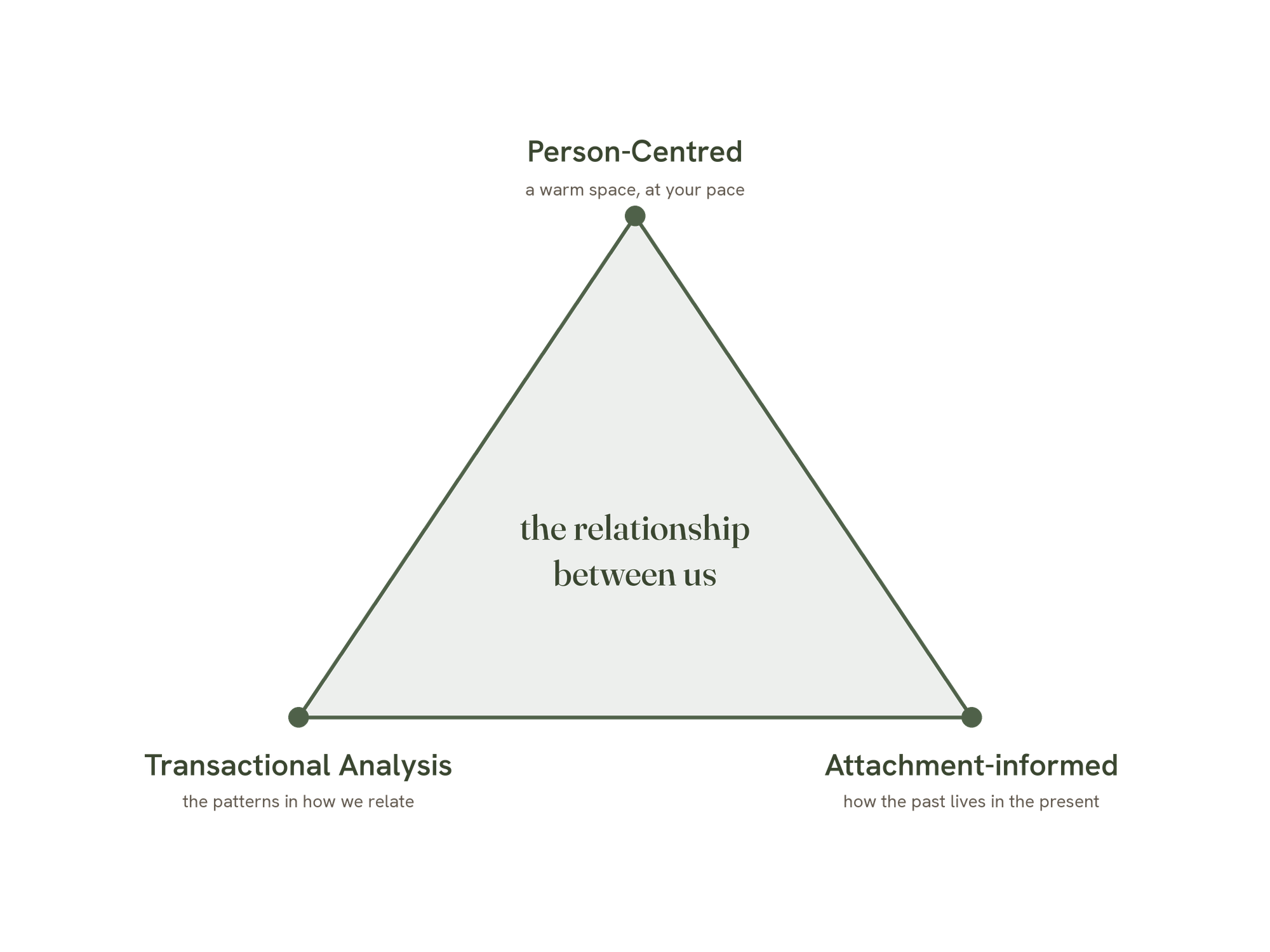
My approach is integrative, which simply means I draw on more than one way of working and shape the therapy around you, rather than fitting you to a single method.
A great deal of it is simply space. Most people have nowhere in their life where they can say what they actually think and feel without managing someone else's reaction. There is nothing you need to achieve here and nobody keeping score. You set the pace.
Alongside that, I pay close attention to the patterns in how we relate to ourselves and to other people, which are often learned early in life and tend to run the show without us noticing. That might be the part of you that says yes when you mean no, or the voice that tells you everyone else is managing better, or the habit of being fine until you are suddenly not. Transactional Analysis gives us a clear language for noticing those patterns, and for finding some choice in them.
I am also attachment-informed, which matters because the ways we learned to connect, to please, to withdraw or to protect ourselves in our earliest relationships tend to repeat in our adult ones, in friendships, at work and in love, often in ways that catch us off guard.
If you are neurodivergent, I adapt how I work rather than expecting you to fit the usual shape of therapy. That might mean agreeing between us that I will bring us back on track when a session wanders, or working with less eye contact, or simply taking things at a slower pace. We work out together what actually helps.
Underneath all of it is the relationship between us, which is what the research suggests helps the most.
Qualifications and professional standards
Master's in Integrative Counselling, Leeds Beckett University
Registered Member of the British Association for Counselling and Psychotherapy (MBACP)
Six years teaching, four in a specialist SEN school
Fully insured and working within the BACP Ethical Framework, with regular clinical supervision
If any of this resonates, I'd be glad to hear from you. The free consultation is a relaxed, no-obligation conversation to see how it feels to talk.